The Fascinating Thing That Keeps High Achievers Stuck at Work
What if some of the habits that made you successful at school are now quietly limiting your success at work?
For high achievers, this can be an uncomfortable realisation.
Academics teach us a relatively predictable equation:
Work hard → get the right answer → receive a good result → receive validation.
The workplace is very different.
A perfect score is seldom achieved. Answers are often ambiguous, and feedback can vary. Even when everything is done correctly, the expected outcome may still not be realized.
This can be particularly challenging for people who have built their identity around achievement.
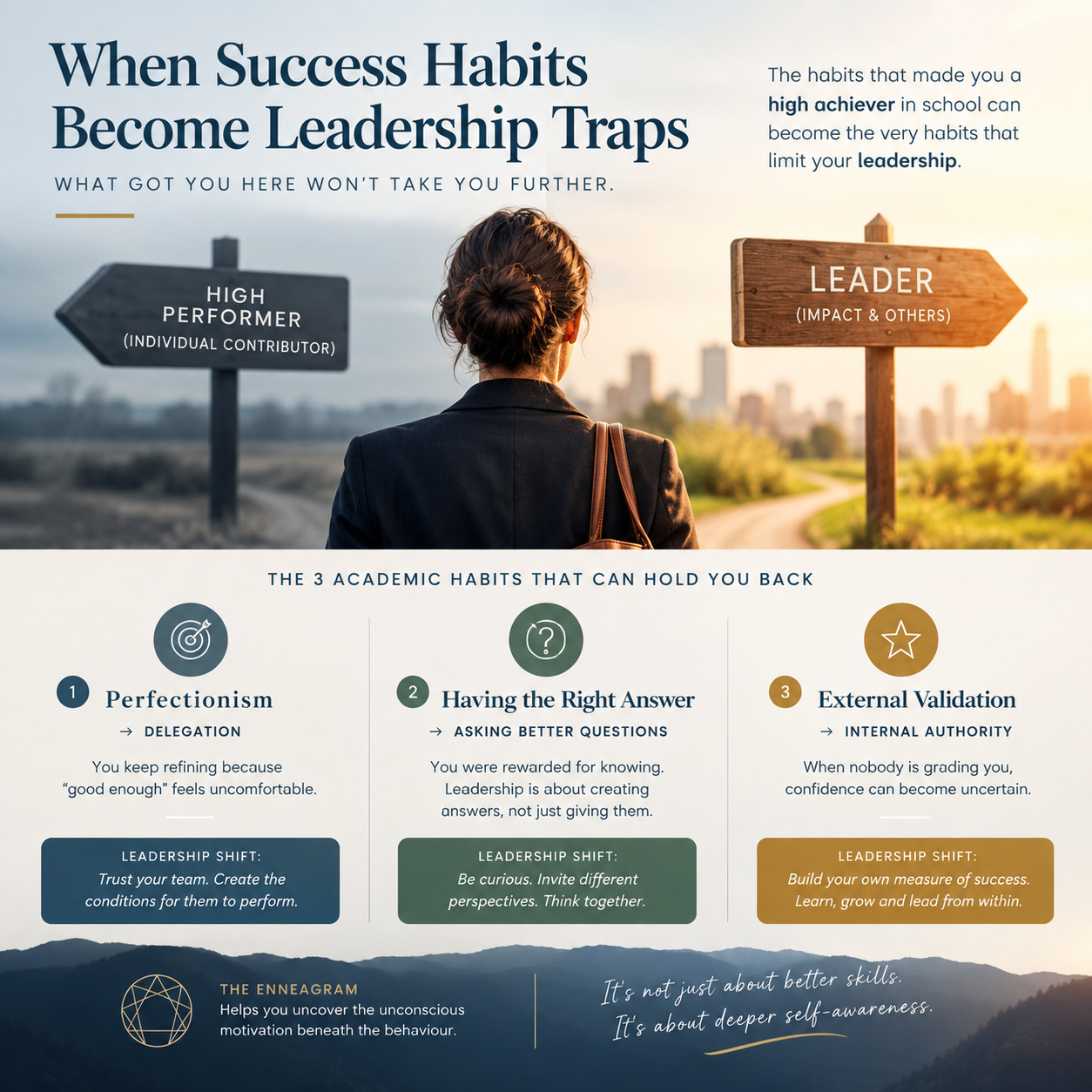
Three academic habits can be especially restrictive: striving for perfection, delaying action until they find the perfect answer, and depending on external approval.
But beneath these behaviours is something more interesting:
The pattern driving them.
When Excellence Becomes Perfectionism
High achievers often pride themselves on having high standards.
And high standards are not the problem.
The problem begins when excellence becomes a strategy for avoiding the possibility of being wrong, criticised, or inadequate.
At university, perfection feels achievable. There is a syllabus, a marking system and often a clearly defined answer.
At work, there isn’t.
Priorities change. Information is incomplete. Decisions have consequences. Sometimes you have to act without knowing whether you have made the “right” choice.
This is where perfectionism can become a trap.
You over-prepare.
You overthink.
You keep refining something that is already good enough.
You delay decisions because you are waiting to feel certain.
The result?
Your pursuit of excellence is starting to cost you effectiveness.
The question is not:
“Can I make this better?”
There will almost always be a way to make something better.
The better question is:
“Will making this better meaningfully improve the outcome?”
That is the difference between excellence and perfectionism.
When You Wait for the Right Answer
A good student learns to answer questions correctly.
A skilled professional must learn to ask more effective questions—and occasionally craft the answers themselves.
This is a significant psychological shift.
When your manager gives you an ambiguous assignment, your instinct may be to ask:
“What exactly do you want me to do?”
But sometimes your manager does not have the answer.
They’re consulting you because your insight is valuable.
Uncertainty doesn’t always mean you’re unready.
It may be an invitation to lead.
Instead of waiting for certainty, try:
“Here is how I understand the problem. Based on what I know, this is how I would approach it.”
You have moved from student to contributor.
From answer-seeker to thinker.
From being evaluated to creating value.
And that shift is essential for leadership.
When You Need Someone Else to Tell You You’re Doing Well
University provides constant feedback.
A mark tells you where you stand.
Work rarely does.
Your presentation may receive a brief “Great job.”
Your email may receive no response.
Your manager may be too busy to provide meaningful feedback.
For someone accustomed to external measurement, this silence can be uncomfortable.
And the mind begins filling the gap.
Was that good enough?
Did I say the wrong thing?
Why hasn’t my manager responded?
Do they think I’m capable?
The problem is not wanting feedback.
Feedback is essential for growth.
The issue arises when feedback is used as the basis for one’s self-esteem.
The more you rely on external validation, the more control others have over your perception of your own competence.
A healthier question is:
“What evidence do I have about how I performed?”
What worked?
What didn’t?
What did I learn?
What would I do differently next time?
You are developing an internal feedback system rather than waiting for someone else to grade you.
The Enneagram: What Is Really Driving the Pattern?
This is where the Enneagram offers another layer of insight.
Two high achievers can behave in exactly the same way while being driven by completely different fears.
One may pursue perfection because being wrong feels unsafe.
Another may overwork because achievement has become connected to worth.
Another may hesitate because making the wrong decision feels threatening.
Another may seek reassurance because uncertainty feels difficult to tolerate.
The behaviour is visible. The motivation underneath it is often invisible.
This is why simply telling a high achiever to “stop overthinking” rarely works.
The behaviour is serving a deeper psychological purpose.
Until the person becomes aware of the underlying pattern, they might keep repeating it—even if they realize it is holding them back.
The Leadership Shift
The transition from academic success to professional leadership requires a new set of internal rules.
You no longer need to:
Get everything right.
Make sound decisions with imperfect information.
You no longer need to:
Wait for the answer.
You need to develop the confidence to offer your thinking.
You no longer need to:
Be constantly validated.
You need to develop the capacity to evaluate yourself honestly.
In other words, the workplace asks you to move from proving yourself to trusting yourself.
And that can be one of the most difficult transitions for a high achiever.
The Question Worth Asking
What if your greatest professional limitation isn’t a lack of knowledge, ability, or ambition?
What if it is an old success strategy that you have never questioned?
The habits that helped you achieve may still be valuable.
Your discipline.
Your curiosity.
Your commitment.
Your high standards.
But they may need an update.
Because success at work is not about achieving the perfect score.
It is about thinking independently, navigating uncertainty, creating value, and trusting yourself when nobody is standing there with a red pen.
You are no longer a student waiting to be graded.
You are an adult who can create the answer.
And perhaps the next level of your leadership begins when you stop asking:
“Am I doing this right?”
And start asking:
“What does this situation require from me now?”
#Leadership #LeadershipDevelopment #Enneagram #SelfLeadership #EmotionalIntelligence #IntegrativeCoaching #PersonalGrowth