Fascinating Truth About Self-Awareness vs. Self-Transformation
Personality assessments have become a staple in leadership development, coaching, and team building. Two of the most widely used frameworks are the Enneagram and the Myers-Briggs Type Indicator (MBTI®).
At first glance, they appear to serve the same purpose: helping people understand themselves and others.
But beneath the surface, they ask very different questions.
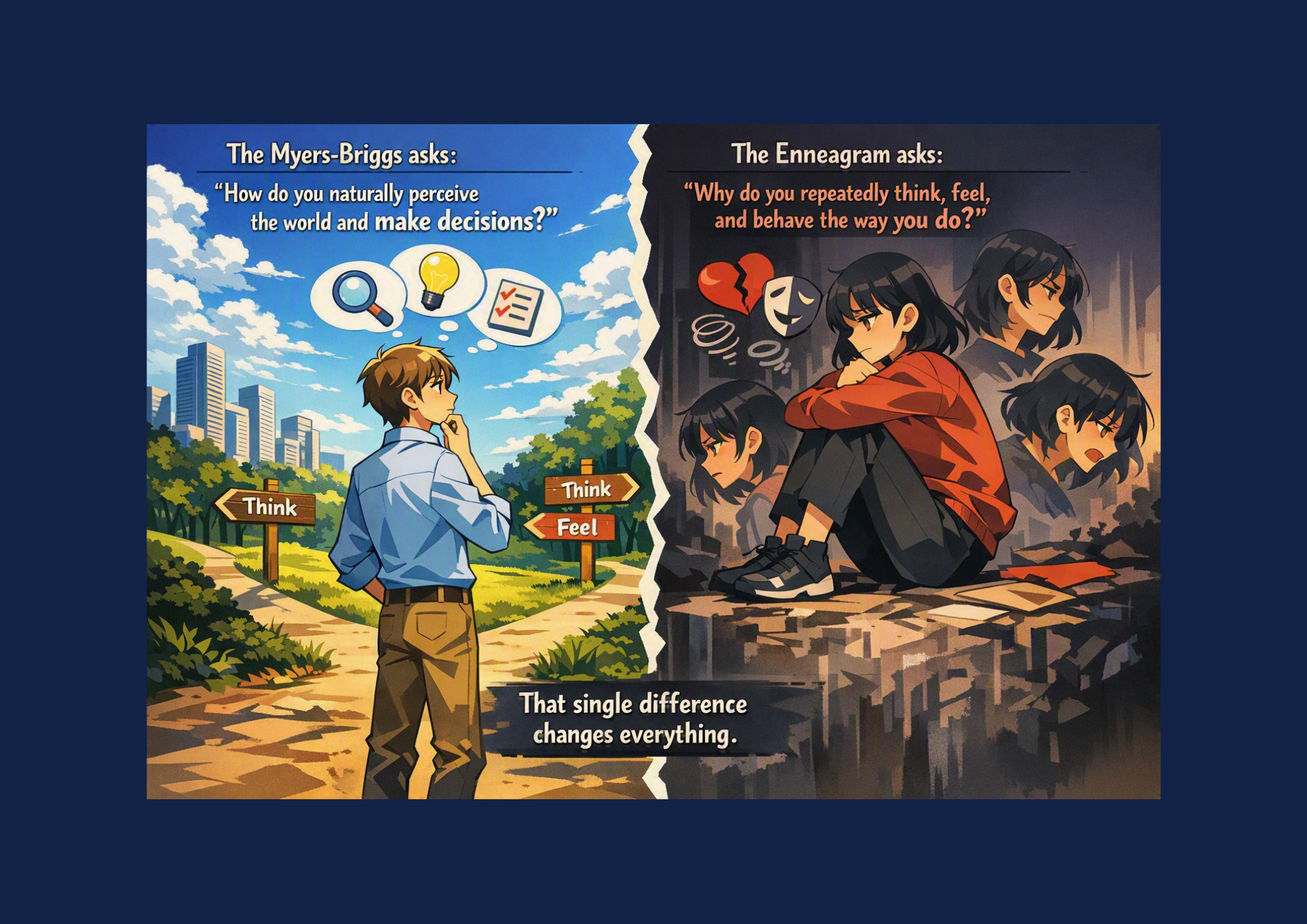
The Myers-Briggs asks, “How do you naturally perceive the world and make decisions?”
The Enneagram asks, “Why do you repeatedly think, feel, and behave the way you do?”
That single difference changes everything.
Myers-Briggs Explains Personality Preferences
The Myers-Briggs Type Indicator identifies sixteen personality types by exploring four areas of preference:
- Introversion or Extraversion
- Sensing or Intuition
- Thinking or Feeling
- Judging or Perceiving
These preferences explain how individuals typically collect information, communicate, organise their lives, and address problems.
For example, an introvert recharges through solitude, whereas an extrovert gains energy from social interaction. A thinker tends to prioritise logic, while a feeler emphasises values and relationships.
The MBTI offers useful insights into how people communicate, work together, and lead. It clarifies differences without suggesting that one style is superior.
In many organisations, it enhances teamwork by encouraging individuals to value diverse approaches to thinking and working.
The Enneagram Explores Motivation
While Myers-Briggs focuses on preferences, the Enneagram explores motivation.
It asks:
- What are you trying to protect?
- What do you fear losing?
- What unconscious belief drives your decisions?
- What emotional habit keeps repeating?
The Enneagram describes nine personality types, each centred on a fundamental fear, a core desire, and a usual approach for establishing safety, worth, or control.
Instead of just describing behaviour, it clarifies the emotional structure underlying it.
Two leaders may both appear confident and decisive.
The Myers-Briggs may classify them similarly.
The Enneagram might show that one person is motivated by a desire to succeed, whereas the other is motivated by a need to stay in control.
The behaviour is similar.
The motivation is completely different.
Description Versus Transformation
A key distinction between these two models is their intended purpose.
The Myers-Briggs is primarily descriptive.
It helps you understand your natural preferences and leverage your strengths.
The Enneagram is transformational.
It uncovers unconscious patterns that restrict growth and illustrates a path to increased freedom, emotional maturity, and integration.
It does not simply tell you who you are.
It challenges who you believe you must be.
Stress, Growth, and Blind Spots
Leadership is tested under pressure.
This is where the Enneagram offers a unique advantage.
In stressful situations, each Enneagram type shows specific emotional and behavioural patterns. It also highlights a particular growth path, helping individuals recognise if they are reacting out of fear rather than responding thoughtfully.
The Myers-Briggs can explain how different personalities may approach challenges.
The Enneagram explains why those challenges trigger particular reactions in the first place.
For coaches and leaders committed to lasting change, this distinction is invaluable.
Leadership Through Two Different Lenses
Imagine two managers leading the same team.
The Myers-Briggs could suggest that one person favours organised planning, whereas the other excels with adaptability.
The Enneagram goes deeper.
It may show that one manager unconsciously seeks perfection and fears errors, whereas the other sidesteps tough conversations to keep harmony.
Understanding these hidden motivations changes the coaching conversation entirely.
Leadership development is no longer about improving skills alone.
It becomes about increasing self-awareness.
Integrating Both Models
This is not a competition between two excellent frameworks.
In fact, they complement each other remarkably well.
The Myers-Briggs helps us understand our natural preferences and appreciate diversity.
The Enneagram helps reveal our unconscious motivations and enhances emotional intelligence.
One explains our personality style.
The other illuminates our personality strategy.
Together, they provide a richer picture of who we are and how we relate to others.
The Real Goal
Ultimately, no personality assessment should become another label.
The purpose of these tools is not to place people in boxes.
It is to help them recognise the boxes they have unknowingly built around themselves.
The Myers-Briggs encourages us to value our natural way of engaging with the world.
The Enneagram invites us to question the assumptions, fears, and emotional habits that quietly shape our lives.
One helps us understand ourselves.
The other invites us to transform ourselves.
Final Thought
The question is not whether the Enneagram or Myers-Briggs is “better.”
The real question is:
Are you trying to understand your personality, or are you trying to understand what drives it?
If your goal is better communication, stronger teamwork, and an appreciation of personality differences, the Myers-Briggs is an excellent tool.
If you’re seeking greater self-awareness, emotional intelligence, and enduring personal growth, the Enneagram provides a strong pathway.
Because true leadership begins not with understanding how you think, but with understanding why you think the way you do.
#Leadership #EmotionalIntelligence #Enneagram #LeadershipDevelopment #IntegrativeCoaching #SelfLeadership #PersonalGrowth


